Average Reviews:

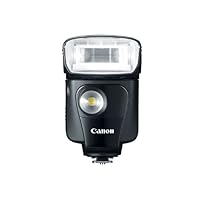
(More customer reviews)I just received the new Canon Speedlite 320EX today and was very excited at the results. I have many reasons why I bought this flash, even though I already own two 580EX II. Two of the primary reasons are:
1) I wanted a more compact flash for "everyday" use
2) I was attracted to the constant LED light for movies or even still photos
QUICK LOOK:
PROS: relatively small, very powerful, LED light provides constant lighting, no LCD screen for more advanced controls, can be used as a wireless slave
CONS: no manual power controls on flash (only thru camera body), LED and main
flash cannot be used at the same time, relatively pricey compared to 430EX II, flash zoom is controlled manually, recycle time on full power is slow
THE BENEFITS
I'm a semi-professional photographer who shoots a lot of corporate events, kids' birthday parties and family portraits for profit as a serious side business. I have two 5D Mk II and two 580EX II that I use for those occasions. Naturally, I end up taking alot of photos of my own kids also, and I felt that lugging around a full frame camera (with a battery grip), the Canon 24-70mm 2.8 lens and the 580EX II was getting pretty cumbersome for casual shooting, so I wanted to lighten the load a bit. I didn't want to give up the full frame nor the awesome 24-70mm (although I sometimes shoot with my 50mm 1.2), so the best way to reduce the bulk was to get a smaller flash. I could have gotten the 430EX, but it was still a bit larger than I wanted. When Canon introduced the 320EX, I felt this was it. I didn't need all the power of the 580EX II nor the 430EX, since I was finding myself shooting at 1/16 the power most of the time when the flash is on manual, so the 320EX should provide enough juice.
The 320EX is definitely alot smaller and lighter than my 580EX II, so I'm satisfied there. I was right about it being powerful enough for my "everyday" usage of capturing my kids' moments, as test shots in the evening in my living room proved to be extremely adequate. Comparison shots between the 320EX on auto (it only has auto, no manual power when controlling directly from the flash itself; manual settings are through the camera body) and the 580EX II on my standard 1/16 manual power looked to be virtually identical when I brought the photos into Adobe Lightroom for scrutiny. Therefore, for my non-professional shoots, this flash satisfies the reduction in weight and size, while providing enough power.
Another alternative to the 320EX was the 270EX or 270EX II, but I felt that they wouldn't provide enough power in some of the darker everyday situations. Plus the 270EX doesn't have AF assist beams, which the 320EX does in either the LED light or through pre-flash firings. I haven't tried the 270 EX in enough scenarios (I don't own one, I borrow my friend's from time to time), so I can't say for certain that it does or doesn't have enough power, but the 320EX seemed to be the perfect compromise that I'm looking for.
Another feature that really intrigued me was the constant LED light for video shooting or still photos or focus assist lighting. I wasn't looking for nor expecting this feature, so it was a real bonus that Canon included it. In the few test videos that I've shot so far though, I found the light to be a bit harsh, as shadows are very strong. I don't know if there's a way to control the strength of the LED light (haven't read the manual yet :P), but there is a manual vs. auto toggle for the LED. Switching it to auto seems to leave it to the camera to decide if the light should be turned on or off, not a control for the light strength. I have to play with the LED more to figure out how to optimize it, but I suspect that putting a diffuser in front of the light will greatly enhance its usage more (though decreasing its power). You can also set it off camera, as the LED will turn on when the 320EX is standalone and the LED control is switched to manual on. BTW, a cheap but effective diffuser is a piece of white napkin or tissue taped over any flash.
THE DOWNSIDES
Now that I've gone over the pros, let me dive into the cons of this flash. It doesn't allow manual flash control from the flash itself like the 430EX or 580EX, so you have to either 1) rely on your camera's light meter and flash compensation in auto mode, or 2) you have to use the flash control menu from your DSLR (External Speedlite control). Some of the older DSLRs either don't have this feature at all, or you will have to update your camera's firmware. I remember that my XTi didn't have it, as it was a beginner's camera. Relying on your camera to meter the flash automatically ultimately leads to uneven lighting from shot to shot, which is why the pros (and the semi-pros) use manual flash whenever possible. The 320EX also doesn't have an LCD screen on the back, as everything is controlled using buttons and switches. This allows it to save on space and reduce the size of the unit, but removes the advanced functions that Canon is guessing its target audience won't need. Perhaps the biggest downside is that the flash head has to be extended out manually for telephoto shots (defined by Canon as 50mm equivalent focal length) and back in for wide angle. As someone who loves to use the 24-70mm as my everyday lens, I can't see myself extending and retracting that thing manually everytime I shift focal lengths. I will most likely leave it on whichever setting I find most versatile, since my goal is to maximize simplicity for the shots that I will be taking with this. The 430EX II and the 580EX II automatically extend the flash internally in accordance to your focal length, or you can set it manually.
Another obvious downside is that it doesn't output as much power as the 430EX or 580EX. For my professional shoots, I may bring the 320EX as a backup, but not as a primary. Additionally, it doesn't have the built-in catch-light card or the wide angle diffuser that the 580EX has. I guess you don't need the wide-angle diffuser, but the catch-light would have been nice so that you can just point the flash up with the catch-light out for some diffused lighting. This will work both indoors and outdoors.
One final downside that I can think of is its price tag. At only $50 cheaper than the 430EX II, you get alot less features than the 430EX II, so definitely take that into consideration. If this was $100 cheaper than the 430EX II, then I would have been ecstatic. As of now, I'm simply happy =).
OTHER FEATURES
The 320EX also can be triggered as a slave flash wirelessly, and you can choose among 1 of 4 standard Canon channels and 1 of 3 standard groupings. That would make this a decent fill light or hair light if you like to shoot Joe McNally-style, but Joe himself probably wouldn't use this because you can't control the power output easily (without manual power controls, you would have to use the power ratio feature controlled by the master flash when the 320EX is off camera). I haven't played with the wireless feature yet, but have no doubt that it would suit my needs as long as I keep its limitations in mind. It also has the ability to swivel up and down with 4 locking positions, and pivot around to point completely backwards, which will be useful when trying to bounce light.
SUMMARY
To wrap everything up, this is the perfect sized and powered flash that I was looking for in my casual shooting, and I think most people will agree. Those who are looking for alot of power shouldn't get this flash, nor those who want a master flash to control slave flashes (this can only be a slave, not a master), nor manual power control... you get the point. The key is to understand what you're searching for in a flash and get the one that's suited for you. For that reason, I'm giving this 5 stars, because it meets and exceeds what I was looking for, despite its slightly higher price tag. As I play with this new toy more, I will come back and update this review and post some photos. In the meantime, check out the photos that I took of the 320EX next to the 580EX II and the sample flower shot.
5/22/11 Update:
I've played with this flash alot indoors now and I'm pretty impressed by the amount of power that it packs. I'm back to shooting with manual flash control through the camera, and in a room that would otherwise come out completely dark when using the 50mm lens at f/4.0, 1/60 sec and ISO 100, I can get a perfectly lit photo by cranking the flash up to full power. Or I can switch the ISO to 400 and shoot at f/8.0, which is pretty sweet. THE ONLY PROBLEM is that the 320EX at full power recycles pretty slowly, but I guess that's as expected. Even the 580EX II would lose every other shot during burst mode at full power. I'd say that the 320EX needs almost a full second to recycle at full power, but if you're manually shooting at full flash, you probably know what you're doing and might have a different flash for this usage or can time your shots properly. At f/1.8, I can drop down the manual flash output down to around 1/4 power, and the recycling lag issue goes away.
Oh, if you're shooting indoors and you have a white ceiling, point the flash up at a 60 degree angle (there are markers for 60 and 70 degrees on the flash head) and bounce the light off the ceiling. It will illuminate your entire room instead of blowing out your subject for a beautiful effect.
5/29/11 update
I've updated portions of my original review for typos and a couple of minor corrections. I'm updating this now from my vacation in Aruba, where this flash has been a rock star. It packs a much more powerful punch than I expected -- I can overpower the sun at somewhere between 1/2 and 1/4 power, meaning that I...Read more›
Click Here to see more reviews about: Canon Speedlite 320EX Flash for Canon SLR Cameras
In a first for Canon Speedlites, the versatile new Speedlite 320EX features an LED light on the front of the flash body that can be used to illuminate nearby subjects in dim light. The light is ideal for video recording but can also be used as a modeling light or as an AF assist beam during Live View shooting. When used with EOS DSLRs that have integrated Speedlite transmitters, the Speedlite 320EX can be used as a wireless slave unit positioned off-camera.A flash release function further facilitates wireless flash shooting by enabling the shutter to be released remotely from the Speedlite 320EX with a two-second delay, which gives the photographer time to re-aim the flash if necessary. The Speedlite 320EX combines rich bounce functionality with high performance, ensuring smooth, professional-looking results.Flash coverage and guide number can be changed manually by extending or retracting the flash head. The Normal position provides wide coverage equivalent to a 24mm lens (full-frame) with a guide number of 79 (ft.) / 24 (m) at ISO 100. The Tele position boosts the guide number to 105 (ft.) / 32 (m) at ISO 100 while providing coverage for lenses 50mm and longer (full-frame).Lightweight, pocket-sized, grip-friendly, and with an intuitive, easy-to-operate design, the Speedlite 320EX is powered by 4 AA batteries (not included) and recharges silently in approximately 2 seconds.
 Get 1% OFF
Click here for more information about Canon Speedlite 320EX Flash for Canon SLR Cameras

No comments:
Post a Comment